The Shift from Assertion to Proof in Vendor Risk Management
- Kirk M. Anderson, MBA, CISSP, CISM, PMP

- Mar 29
- 5 min read
Updated: May 18
The distinction sounds academic until it is tested. And it is being tested right now. Regulators no longer accept documentation as evidence. Insurers no longer accept process as verification. Boards are learning the hard way that a completed questionnaire is not the same as a defensible record. This is not a technology problem. It is a governance problem. Organizations that understand this difference are already separating from those that do not.
The Question That Changes Everything
Every major breach eventually reaches a pivotal moment. It's not the technical investigation, containment, or forensics report that matters most. Instead, it’s a different kind of question that arises at the worst possible time. The incident is public, pressure is high, and the margin for error is gone. This question comes from a regulator, legal counsel, or the board.

This is where most vendor risk programs fail. They are not poorly built or understaffed; they were never designed to answer that critical question. They were built to document a process. Documenting a process is not the same as producing evidence.
A SOC 2 report filed eleven months ago proves a conversation happened. It does not prove the vendor was secure at the time of the incident. A completed questionnaire shows a form was submitted. It does not prove the answers were accurate when the breach occurred. A GRC platform demonstrates a workflow was followed. It does not prove that the output of that workflow reflected reality.
The process can be flawless, yet the proof can still be absent. When the question arises, the absence of proof is not just a technicality; it is a liability.
The Hidden Gap in Modern Cybersecurity
Traditional vendor risk management is built on a simple assumption: trust can be established through assertion and maintained through periodic validation. This assumption held for decades, but it no longer holds.
The environment has shifted beneath this model. Attackers now target the trust relationships themselves. Supply chain compromises exploit the gap between a vendor's last assessment and the present moment. Organizations that get breached through these relationships often discover, during the worst possible week of their year, that their entire vendor risk apparatus was designed to record what vendors said about themselves, not to verify whether any of it was still true.
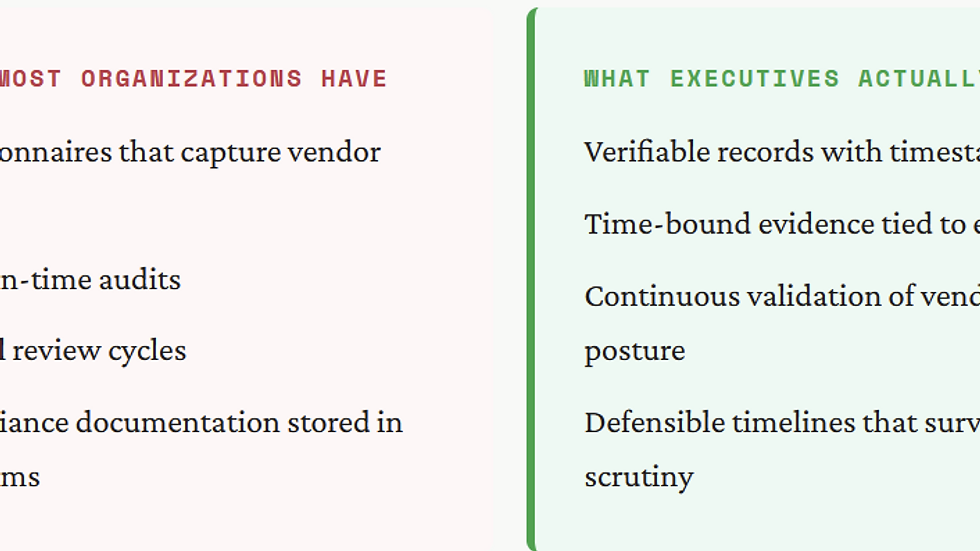
The gap between these two columns is where business risk now lives. It is expanding every quarter. Most organizations are unaware it exists until the question from Part I is asked.
Why This Is a Business Problem, Not a Cyber Problem
This issue is not about better security tooling. Better tools applied to the same structural assumption produce the same structural gap. This is about business exposure that is no longer contained within IT. The consequences now reach four areas that report directly to the board.

None of these consequences are theoretical. They are manifesting in settlement negotiations, insurance renewals, regulatory examinations, and boardroom conversations right now. They share a common root cause: the organization had a process but could not produce proof.

From Assertion-Based Security to Proof-Based Security
What we are witnessing is not an incremental evolution of vendor risk management; it is a replacement model. The old model assumed trust could be established through assertion and maintained through periodic review. The emerging model requires trust to be recorded as evidence and validated continuously. The difference is not a matter of degree; it is structural.

Today's vendor risk programs are akin to filing cabinets. They store what was submitted. What executives need is a flight recorder. This captures what actually happened, when it happened, and preserves it when it matters most. A filing cabinet is useful until someone asks a hard question. A flight recorder is built for those tough inquiries. This is the next control layer in cybersecurity. Not a new dashboard or a better questionnaire, but a different foundation for how vendor trust is established, maintained, and proven.
What Proof-Based Vendor Trust Actually Requires
This shift is not about adding another tool to an already crowded stack. It requires a different foundation. Three capabilities define whether an organization has crossed the line from assertion to proof.

When these three capabilities exist, the organization can answer the question from Part I with evidence. Without them, the answer depends on reconstruction, which is what organizations do after they have already lost the argument.
Why This Shift Is Happening Now
Three forces are converging simultaneously, making the proof gap urgent rather than aspirational.
Attackers Now Target Trust Relationships
Supply chains have become the most efficient attack path available. A single compromised vendor can cascade into hundreds of downstream organizations through inherited access and trusted connections. The attacker does not need to breach your perimeter; they need to breach your vendor's perimeter. Your trust in that vendor does the rest. When trust is the attack surface, documenting trust is not a defense; verifying trust is.
Regulators Now Demand Evidence
Regulatory frameworks are shifting from evaluating whether controls exist to evaluating whether controls produced outcomes. The SEC's 2026 examination priorities explicitly focus on third-party vendor oversight and the ability to demonstrate governance. CMMC enforcement is active. The EU Cyber Resilience Act raises the bar further. In each case, the standard is not process; it is demonstrable proof.
Insurers Now Require Verification
The cyber insurance market has moved from underwriting based on policy declarations to underwriting based on evidence of active controls. When a claim is filed, the carrier's first question mirrors the regulator's: Can you prove the controls were functioning at the time of the incident? Without proof, coverage breaks down. The premium was paid, but the claim is denied. The organization absorbs the full cost of a breach it thought it was insured against.
This is not a future state; this is the current operating environment.
The Separation Is Already Happening
Organizations are dividing into two groups. This division is not based on size, industry, or budget. It is based on whether their vendor risk programs produce process artifacts or evidentiary records.

That separation is accelerating. Every breach, every regulatory update, and every insurance renewal cycle widens the distance between these two groups. The window to move from the second group to the first is still open, but it will not stay open indefinitely.

The supply chain threat is not slowing. The regulatory environment is not softening. The insurance market is not becoming more forgiving. Assertion-based security is no longer defensible. Proof-based security is becoming a requirement.
Digital provenance is not a feature; it is the next control layer. The line between organizations that can defend their decisions and those that can only describe their process is already forming. Most will not see it until they are asked to prove something they cannot.
The shift is already happening, not because organizations want it, but because the environment now demands it. The only question is whether the transition happens before the breach or because of it.
If your vendor risk program cannot produce proof of what it knew at any point in time, it is not a control. It is a liability.


Comments