When the Security Tool Becomes the Attack Surface

For years, organizations have operated under a simple assumption:
If the security tools are running, we're protected.
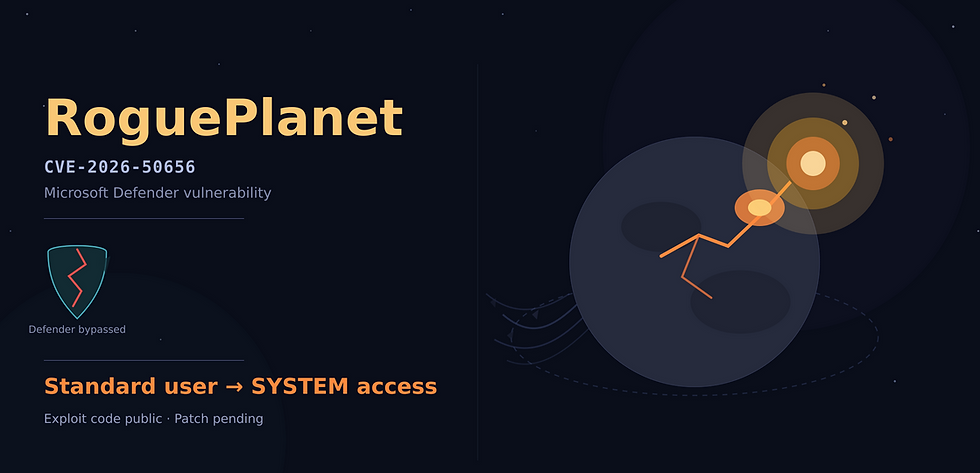
A newly disclosed Microsoft Defender vulnerability, and the broader pattern of Defender exploits that preceded it, demonstrates why that assumption deserves a second look.
What Happened
In June 2026, a security researcher publicly released exploit code targeting a flaw within Microsoft Defender, Microsoft's built-in endpoint protection platform. The vulnerability, tracked as CVE-2026-50656 and publicly referred to as "RoguePlanet," allows an attacker who has already gained a foothold on a system to escalate their access to SYSTEM privileges, the highest level of control available on Windows. Microsoft published the CVE on June 16, 2026, and has rated it "Exploitation More Likely" under its own exploitability index.
What makes this story notable is not just the vulnerability. It is where the vulnerability exists.
The flaw is not in a forgotten third-party application or an obscure piece of software. It lives inside the security platform most organizations rely on as a foundational layer of defense.
Microsoft has acknowledged the issue and confirmed a fix is in development, but no patch is yet available.
It Happened. Recently.
RoguePlanet has not yet been observed exploited in the wild. But that distinction offers less comfort than it sounds.
Two months earlier, a closely related vulnerability in the same product followed exactly the path this one is now on. In April 2026, a different Defender privilege escalation flaw, known as BlueHammer (CVE-2026-33825), was publicly disclosed with working exploit code before a patch existed. Within days, endpoint security firm Huntress documented a live intrusion in which attackers had already deployed the exploit against a real target. The attacker had gained initial access through a single compromised VPN account, staged the exploit tools in the victim's own file system, and was running manual reconnaissance commands across the environment before the organization knew it had been breached.
Huntress caught the activity in progress and isolated the organization before further damage occurred. Many organizations would not have caught it at all.
RoguePlanet is the fourth Defender exploit published by the same researcher behind BlueHammer. The window between public disclosure and active exploitation in this cluster has been measured in days, not weeks.
Why Executives Should Care
In the BlueHammer intrusion, it took one reused password and one vulnerable endpoint. The security tool that was supposed to stop lateral movement became the path forward for the attacker.
The lesson from RoguePlanet is not that Microsoft Defender is ineffective. The lesson is that security tools are software, and software can fail.
Every organization has quietly built these assumptions into its risk model, often without documenting them and rarely testing whether they still hold:
Antivirus will stop malware.
Endpoint detection will alert us.
Security controls will remain operational during an attack.
Administrative privileges are restricted.
RoguePlanet breaks the third assumption. And when that one breaks, the others become significantly harder to rely on. The question is no longer "Do we have security tools?" The question is "What happens when those tools fail?"
Business Impact
A Local Problem Becomes a Company-Wide Event
Privilege escalation is the bridge between a contained incident and an enterprise-wide crisis. SYSTEM-level access gives an attacker near-total control of a Windows endpoint: they can disable protective controls, harvest stored credentials, establish persistent back doors, and move laterally to other machines, all while appearing as routine system activity.
The timeline on these events is measured in hours, not days. Security teams that rely on alerts to catch lateral movement are often working from a significant deficit by the time the first notification fires. In the BlueHammer intrusion documented by Huntress, the attacker was already running enumeration commands across the environment before the organization knew it had been breached.
Financial Exposure
The financial consequences of a privilege escalation event that goes undetected are not measured in IT staff hours. They are measured in business disruption. Ransomware recovery routinely costs organizations seven figures before accounting for operational downtime, lost productivity, incident response consulting, regulatory investigations, customer notification requirements, and legal exposure.
The short-term cost of addressing this vulnerability now (increased monitoring, detection rule tuning, accelerated patch planning) is measured primarily in staff time and operational focus. That investment is modest compared to the cost of the alternative. For most organizations, a single major incident exceeds years of proactive security spending. The math is not complicated.
Reputation
Boards, regulators, customers, and investors increasingly understand that vulnerabilities are unavoidable. What they evaluate is how effectively leadership responds.
Organizations rarely suffer lasting reputational damage because a vulnerability existed. They suffer lasting damage because they did not know where they were exposed, they reacted too slowly, or they could not explain their response.
In today's environment, incident response capability is becoming as important as prevention capability.
What Leadership Should Ask Now
This event is a good moment to test your assumptions. Bring these questions to your security team:
On visibility: How quickly can we identify which systems are potentially exposed? Hours or days?
On detection: Are we monitoring for privilege escalation behavior, or only for known malware signatures?
On resilience: What compensating controls exist while a patch is unavailable? How would we operate if endpoint protection was partially degraded?
On response: What is our average time-to-remediate for critical vulnerabilities? Could we deploy an emergency fix across the environment within 48 hours if needed?
On continuity: Which critical business processes depend on endpoint protection functioning correctly? What are the manual workarounds if those controls fail?
Push for specific answers, not general reassurances. Vague confidence is not a risk posture.
One Action This Week
Ask your CISO or security lead for a written answer to one question: If an attacker gained local access to one of our endpoints today, how long before we would know, and what would stop them from reaching everything else?
The answer to that question will tell you more about your actual security posture than any dashboard.
The organizations that recover fastest from cyber events are not the ones that assumed their defenses would never fail. They are the ones that planned for the day they might.
Have questions about how this vulnerability affects your organization? Reach out.


Comments